Andalusian Horse
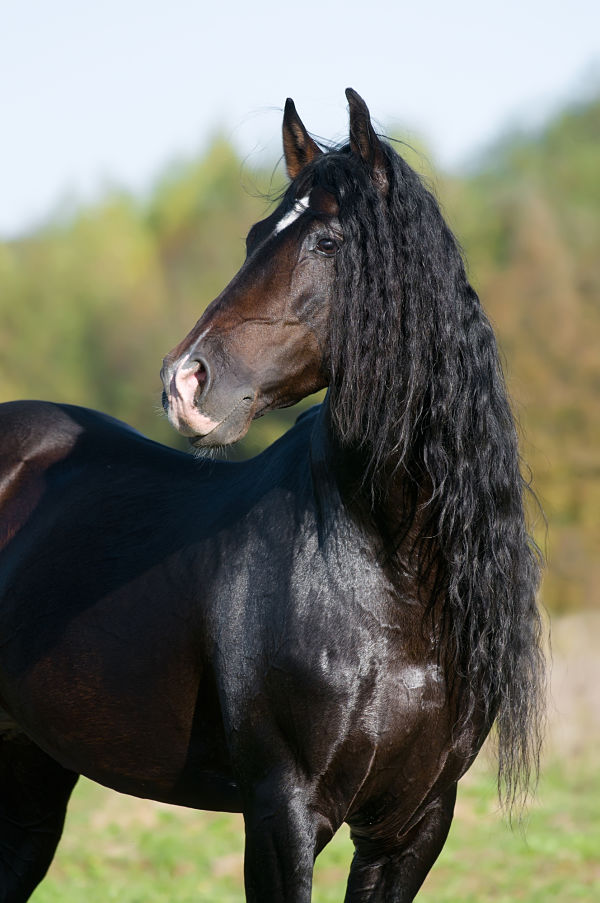
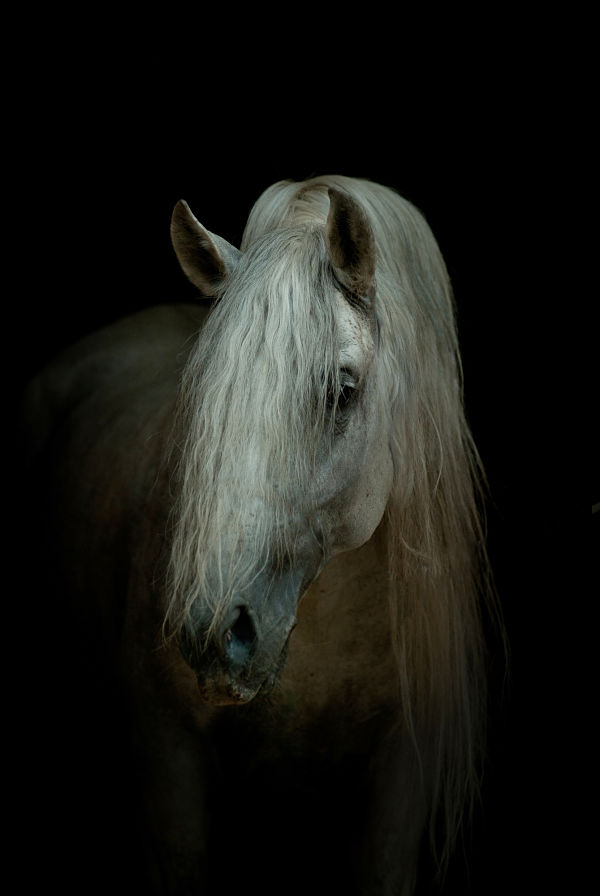 Portrait of an Andalusian Horse
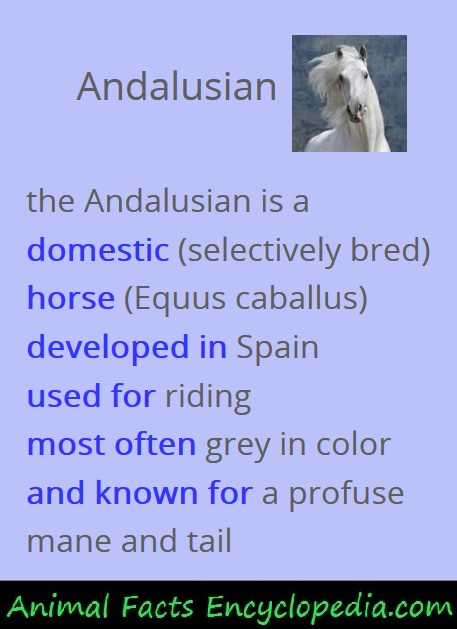
The Andalusian horse breed was developed in Spain, and is one of the worlds most iconic breeds. Known in it's native Spain as the Pura Raza Espanola (PRE) or "Pure Spanish Horse", the Andalusian is a medium sized, powerfully built horse, bred for riding.
They have large, expressive eyes, a long, straight profile, delicate lips, flared nostrils and chiseled cheeks.
The body is rounded, with long, sloping shoulders and smoothly curved haunches. The neck is very muscular, crested and curved. The legs are well formed with "plenty of bone", and the hooves are neat, rounded and hard.
The majority of Andalusian horses are grey in color. Often, like the Lipizzaner horses that are descended from them, they are born black or very dark grey, and will lighten as they age.
Well over 80% of those registered in fact, are some form of silver, grey, black or white, but other colors are seen, and acceptable in some registries. Bay is the most common color other than grey, and occasionally chestnut individuals, and even palominos are seen.
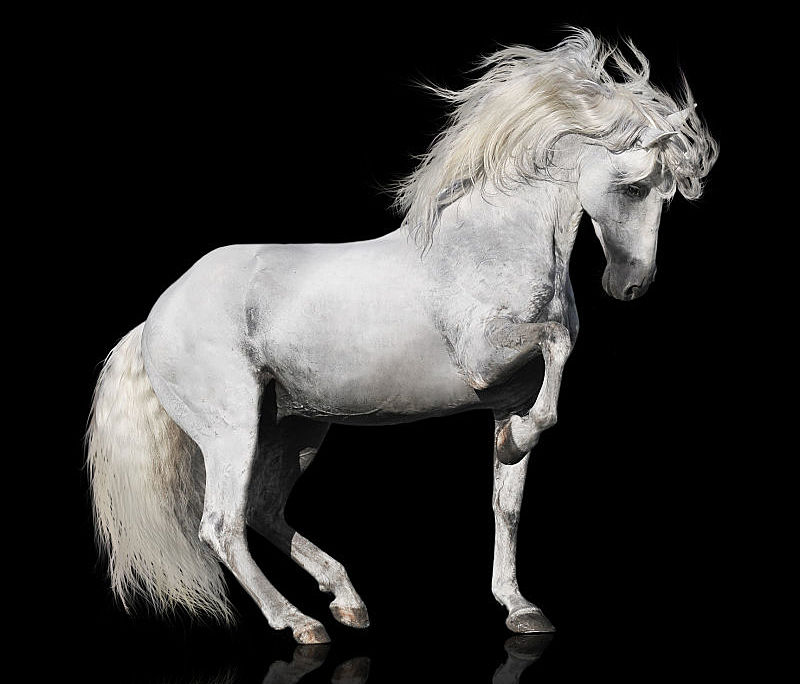
One of the most unique characteristics of the Andalusian horse is a full, flowing mane and tail. The forelock sweeps over the face, and the tail is often long enough to touch the ground.
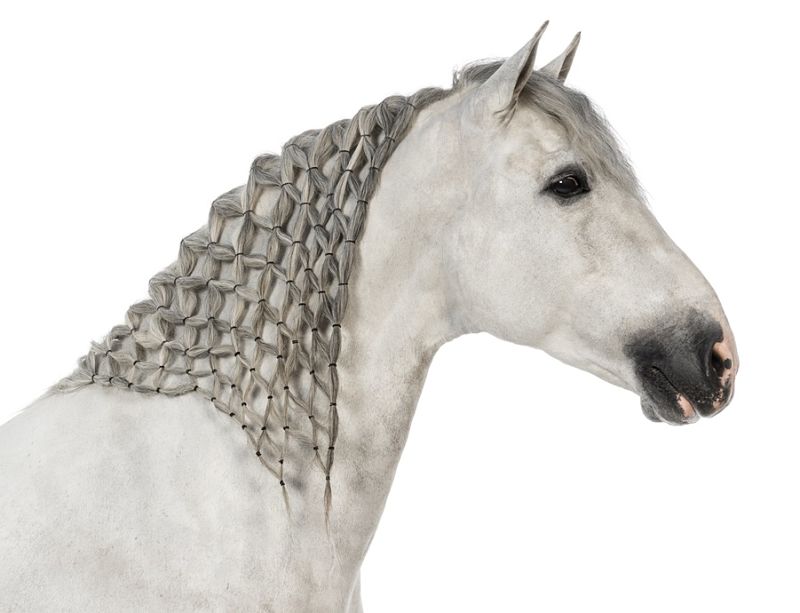
The long mane is sometimes braided in a beautiful style known as "plaited".
Manes and tails may be straight and sleek, but waves and curls are most common. There is little, if any, excessive hair or "feathering" on the legs, and the coat on the body is short and fine with a deep sheen.
Another unique trait is the highly flexible joints of the hocks, knees and fetlocks. This allows for the ability to perform complex dressage movements involving leaps, kicks, and controlled steps resembling a dance.
The neck is powerful and flexible as well, creating the signature profile of a fully collected horse carrying its head and neck in an elegant arch.
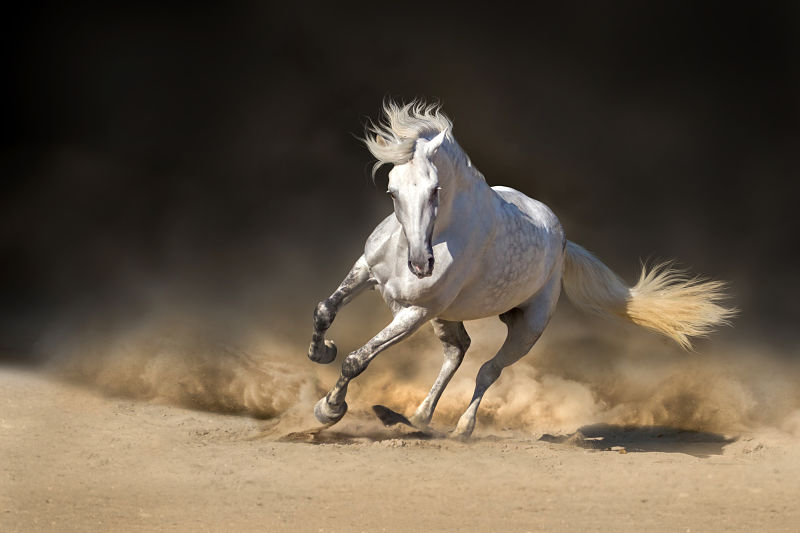
History of the Andalusian Horse
The Andalusian horse, is also known as the Iberian horse, and the P.R.E. which stands for Pura Raza Espanola (pure Spanish horse). It is an ancient breed thought to have been ridden by Roman and Greek noblemen.
Hannibal and William the Conqueror, rode them into battle, and they are the foundation breed of the Royal Lippizan Stallions, the famous white horses that perform dressage at The Spanish Riding School in Vienna, Austria.
The Andalusian played a major role in the history of Spain, first as a cavalry horse that was brave and agile in battle, and then as a source of pride and a symbol of the refinement of Spain, as they became the desired breed for dressage work, and were declared The Royal Horse of Europe.
These beautiful horses were presented as gifts to heads of state, and cherished by elites, and it was said by the Duke of Newcastle in1667 that the Andalusian was “the noblest horse in the world, the most beautiful that can be. He is of great spirit and of great courage and docile; hath the proudest trot and the best action in his trot, the loftiest gallop, and is the lovingest and gentlest horse, and fittest of all for a king in his day of triumph.”
Depletion of the Andalusian horse population occurred over time as many of these horses, used as war horses because of their extreme courage, succumbed during several battles in the 1800's. An epidemic in 1832 impacted many horses, and it is even said that Napoleon's army stole herds of Andalusians from Spain.
In later years, horse fanciers turned their interest toward horse racing. The Andalusian is remarkably agile for its size but is not a swift horse, and was no longer of interest to many elite factions who were turning their interests to racing and steeplechase. Arabian and Thoroughbred blood lines became popular, making the Andalusian increasingly rare.
Modern Andalusian horses were not exported from Spain until the 1960's and because of their rarity were desirable and became highly prized once again. Though still not a common breed, they are re-established all over the world now, and are regularly seen in movies and TV shows because of their intelligence, calmness, train-ability, and of course, stunning beauty.
Today they can be found not just performing dressage moves, but also competing in jumping events, cross-country, and even Western barrel racing!
They make extraordinary companions for horse lovers, as both devoted pets and work partners.
Andalusian Horses in the Movies
Because of its extreme beauty, and great trainability, the Andalusian horse has appeared in numerous Hollywood films, TV series, and blockbuster movies.
In The Lord of the Rings, Gandalf's horse, named Shadowfax, was played by two incredibly well-trained Andalusian horses named Demero and Bianco.
In Robin Hood, Russell Crowe rode an Andalusian named Rusty.
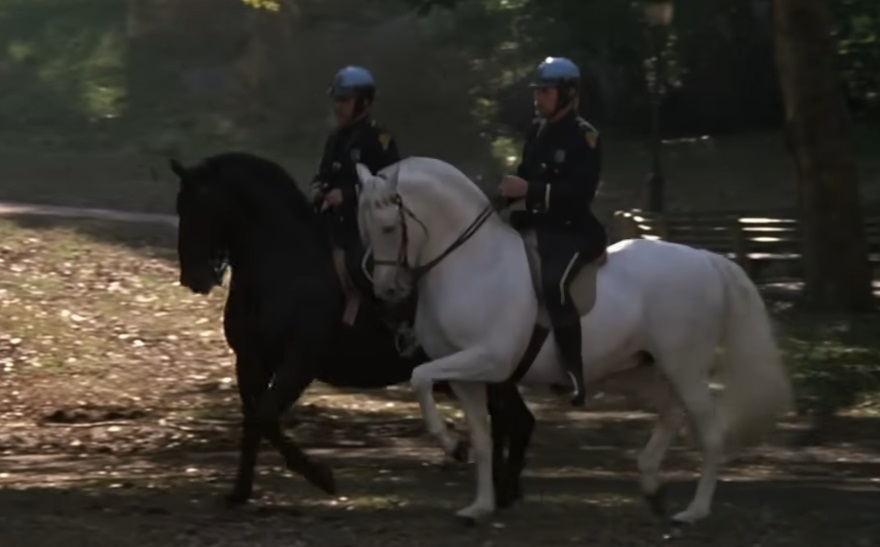
Andalusians were featured in Interview with a Vampire, Game of Thrones, Gladiator, Alexander, Braveheart, the Princess Bride, Sense and Sensibility, and even the movie Hair, where mounted policemen get their Andalusians to 'dance'.
a few more Andalusian Horse facts
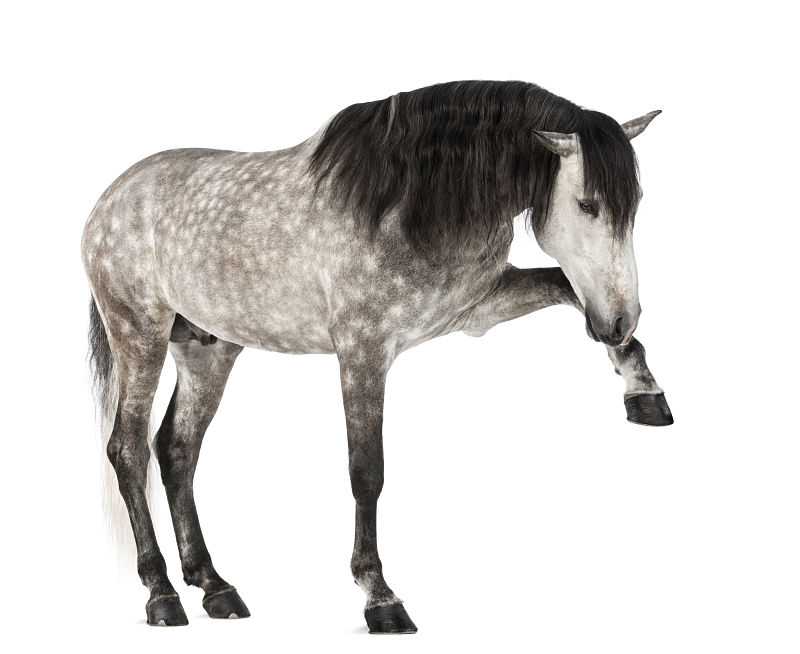
- The Andalusian was used in battle and is extremely agile
- Over 80% of Andalusians are grey in color
- The long mane is sometimes braided in a pattern called "plaited"
- The Andalusian and the Lusitano were once the same breed
- The Lusitano was bred in Portugal
- The Andalusian horse is used in dressage displays
- The Lipizzaner horse is descended from the Andalusian
So Much More to Explore...










see more animal extreme closeups
e-mail us at info@animalfactsencyclopedia.com




Copyright 2011 - 2026 by Jenise Alongi Animal Facts Encyclopedia.com